

- University
- Academic
- Schools/Vocational Schools
- Vocational School of Justice
- Vocational School
- Vocational School
- Department of Banking and Insurance (Turkish)
- Department of Computer Programming (Turkish)
- Department of Foreign Trade (Turkish)
- Department of Graphic Design (Turkish)
- Department of Interior Design (Turkish)
- Department of Construction Technology (Turkish)
- Department of Occupational Health and Safety (Turkish)
- Department of Media and Communication (Turkish)
- Department of Architectural Restoration (Turkish)
- Department of Radio and Tv Programming (Turkish)
- Department of Civil Aviation Cabin Services (Turkish)
- Department of Civil Aviation Transportation Management (Turkish)
- Department of Tourism and Hotel Management (Turkish)
- Department of Applied English Translation
- Vocational School Of Health Services
- Vocational School Of Health Services
- Department of Child Development (Turkish)
- Department of Physiotherapy (Turkish)
- Department of Paramedic (Turkish)
- Department of Opticianry (Turkish)
- Department of Medical Documentation and Secreteriat (Turkish)
- Department of Medical Imaging Techniques (Turkish)
- Department of Medical Laboratory Techniques (Turkish)
- Department of Elderly Care (Turkish)
- School of Applied Management Sciences
- School of Foreign Languages
- Faculties
- Faculty of Arts and Sciences
- Faculty of Fine Arts and Design
- Faculty of Law
- Faculty of Communication
- Faculty of Business
- Faculty of Engineering
- Faculty of Engineering
- Department of Computer Engineering
- Department of Biomedical Engineering
- Department of Electrical and Electronics Engineering
- Department of Industrial Engineering
- Department of Food Engineering
- Department of Genetics and Bioengineering
- Department of Aerospace Engineering
- Department of Civil Engineering
- Department of Mechanical Engineering
- Department of Mechatronics Engineering
- Department of Software Engineering
- Faculty of Health Sciences
- Medicine
- Graduate School
- Common Courses
- Schools/Vocational Schools
- Research
- Research Centers
- Library
- Smart Campus
- Technology Transfer Office
- İzmir Sciencepark
- Continuous Education Center (EKOSEM)
- Children's University
- Ethics Committee
- Teaching and Learning Center (EKOEĞİTİM)
- Psychology Application and Research Center
- Researcher Training Coordinatorship
- Research Collaborations And Innovation Coordinatorship
- Campus
- INTERNATIONAL
- Contact
- 25TH YEAR
Department of Genetics and Bioengineering
GBE 330 | Course Introduction and Application Information
| Course Name |
Nobel Prize-Winning Studies
|
|
Code
|
Semester
|
Theory
(hour/week) |
Application/Lab
(hour/week) |
Local Credits
|
ECTS
|
|
GBE 330
|
FALL
|
3
|
0
|
3
|
5
|
| Prerequisites | None | |||||
| Course Language | English | |||||
| Course Type | ELECTIVE_COURSE | |||||
| Course Level | First Cycle | |||||
| Mode of Delivery | Face to Face | |||||
| Teaching Methods and Techniques of the Course |
Discussion Q&A Lecture / Presentation |
|||||
| National Occupational Classification Code | - | |||||
| Course Coordinator |
|
|||||
| Course Lecturer(s) |
|
|||||
| Assistant(s) | - | |||||
| Course Objectives | The Nobel Prize is an international award administered by the Nobel Foundation in Stockholm, Sweden to “those who, during the preceding year, shall have conferred the greatest benefit on mankind”. By selecting Nobel prize-winning contributions in Genetics and Bioengineering-related areas, this course will focus on exploring the history behind some of the greatest achievements in science. We will further examine the lives of the laureates, the science behind the discovery and the impact of the prize on society. | |||||||||||||||||||||||||||||||||||||||||||||
| Learning Outcomes |
The students who succeeded in this course;
|
|||||||||||||||||||||||||||||||||||||||||||||
| Course Description | This course covers the scientific description and contribution of Nobel Prize-winning studies in the field of Genetics and Bioengineering. | |||||||||||||||||||||||||||||||||||||||||||||
| Related Sustainable Development Goals |
-
|
|||||||||||||||||||||||||||||||||||||||||||||
|
|
Core Courses |
|
| Major Area Courses |
X
|
|
| Supportive Courses |
|
|
| Media and Managment Skills Courses |
|
|
| Transferable Skill Courses |
|
WEEKLY SUBJECTS AND RELATED PREPARATION STUDIES
| Week | Subjects | Required Materials | Learning Outcome |
| 1 | Introduction to Nobel Prize | www.nobelprize.org | LO1 |
| 2 | “Genetic regulation of organ development and programmed cell death” - Sydney Brenner, H. Robert Horvitz and John E. Sulston | Sydney Brenner. Nature’s gift to science. Nobel Lecture, December 8, 2002. https://www.nobelprize.org/uploads/2018/06/brenner-lecture.pdf (28/04/2019 - 14:02) H. Robert Horvitz. Worms, life and death. Nobel Lecture, December 8, 2002 https://www.nobelprize.org/uploads/2018/06/horvitz-lecture.pdf (28/04/2019 - 14:02) John E. Sulston. C. elegans: The cell Lineage and beyond. Nobel Lecture, December 8, 2002.https://www.nobelprize.org/uploads/2018/06/sulston-lecture.pdf (28/04/2019 - 14:02) | LO2 |
| 3 | “Discovery and development of the green fluorescent protein” - Osamu Shimomura, Martin Chalfie and Roger Y. Tsie | Osamu Shimomura. Discovery of green fluorescent protein, GFP. Nobel Lecture, December 8, 2008. https://www.nobelprize.org/uploads/2018/06/shimomura_lecture.pdf (28/04/2019 - 14:02) Roger Y. Tsien. Constructing and exploiting the fluorescent protein paintbox. Nobel Lecture, December 8, 2008. https://www.nobelprize.org/uploads/2018/06/tsien_lecture.pdf (28/04/2019 - 14:02) | LO2 |
| 4 | “The specificity in development and control of the immune system and the discovery of the principle for production of monoclonal antibodies” - Niels K. Jerne, Georges J.F. Köhler and César Milstein | Niels K. Jerne. The generative grammar of, the immune system. Nobel lecture, 8 December 1984. https://www.nobelprize.org/uploads/2018/06/jerne-lecture.pdf (28/04/2019 - 14:02) Georges Köhler. Derivation and diversification of monoclonal antibodies. Nobel lecture, 8 December, 1984. https://www.nobelprize.org/uploads/2018/06/kohler-lecture.pdf (28/04/2019 - 14:02) César Milstein. From the structure of antibodies to the diversification of the immune response. Nobel lecture, 8 December, 1984. https://www.nobelprize.org/uploads/2018/06/milstein-lecture.pdf (28/04/2019 - 14:02) | LO2 |
| 5 | “Odorant receptors and the organization of the olfactory system” - Richard Axel and Linda B. Buck | Richard Axel. Scents and sensibility: a molecular logic of olfactory perception. Nobel Lecture, December 8, 2004. https://www.nobelprize.org/uploads/2018/06/axel-lecture.pdf (28/04/2019 - 14:02) Linda B. Buck. Unraveling the sense of smell. Nobel Lecture, December 8, 2004. https://www.nobelprize.org/uploads/2018/06/buck-lecture.pdf (28/04/2019 - 14:02) | LO2 |
| 6 | “The biochemistry of nucleic acids, with particular regard to recombinant-DNA” - Paul Berg “The determination of base sequences in nucleic acids” - Walter Gilbert and Frederick Sanger | Nicole Kresge, Robert D. Simoni and Robert L. Hill Amino Acyl Ribonucleic Acid Formation and Recombinant DNA Technology: the Work of Paul Berg. The journal of biological chemistry Vol. 280, No. 45, Issue of November 11, p. e42, 2005. Shendure J, Balasubramanian S, Church GM, Gilbert W, Rogers J, Schloss JA, Waterston RH. DNA sequencing at 40: past, present and future. Nature. 2017 Oct 19;550(7676):345-353. doi: 10.1038/nature24286. Epub 2017 Oct 11. | LO2 |
| 7 | “Discovery of cancer therapy by inhibition of negative immune regulation” - James P. Allison and Tasuku Honjo | C. I. Edvard Smith, Rikard Holmdahl, Olle Kämpe & Klas Kärre. Discovery of cancer therapy by inhibition of negative immune regulation. Members of the Nobel Committee and Members of the Nobel Assembly. Karolinska Institutet, Stockholm, September 30, 2018. https://www.nobelprize.org/uploads/2018/10/advanced-medicineprize2018.pdf (28/04/2019 - 14:02) | LO3 |
| 8 | Midterm | - | |
| 9 | “The discovery that mature cells can be reprogrammed to become pluripotent” - Sir John B. Gurdon and Shinya Yamanaka and “Discoveries of mechanisms for autophagy” - Yoshinori Ohsumi | "Sir John B. Gurdon. The Egg and the Nucleus: A Battle for Supremacy. Nobel Lecture, December 7, 2013. https://www.nobelprize.org/uploads/2018/06/gurdon-lecture.pdf (28/04/2019 - 14:02) Shinya Yamanaka. The Winding Road to Pluripotency. Nobel Lecture, December 7, 2012. https://www.nobelprize.org/uploads/2018/06/yamanaka-lecture.pdf (28/04/2019 - 14:02) Yoshinori Ohsumi. Molecular Mechanisms of Autophagy in Yeast. Nobel Lecture, December 7, 2016. https://www.nobelprize.org/uploads/2018/06/ohsumi-lecture.pdf (28/04/2019 - 14:02) " | LO3 |
| 10 | “Discoveries of molecular mechanisms controlling the circadian rhythm” - Jeffrey C. Hall, Michael Rosbash and Michael W. Young | Huang RC. The discoveries of molecular mechanisms for the circadian rhythm: The 2017 Nobel Prize in Physiology or Medicine. Biomed J. 2018 Feb;41(1):5-8. doi: 10.1016/j.bj.2018.02.003. Epub 2018 Mar 29. | LO3 |
| 11 | ”Invention of the polymerase chain reaction (PCR) method” - Kary B. Mullis | Kary B. Mullis. The Polymerase Chain Reaction. Nobel Lecture, December 8, 1993. https://www.nobelprize.org/prizes/chemistry/1993/mullis/lecture/ (28/04/2019 - 14:02) | LO3 |
| 12 | “Discoveries of cells that constitute a positioning system in the brain” - John O’Keefe, May-Britt Moser and Edvard I. Moser | John O’Keefe. Spatial Cells in the Hippocampal Formation. Nobel Lecture, 7 December 2014. https://www.nobelprize.org/uploads/2018/06/okeefe-lecture.pdf (28/04/2019 - 14:02) May-Britt Moser. Grid Cells, Place Cells and Memory. Nobel Lecture, 7 December 2014. https://www.nobelprize.org/uploads/2018/06/may-britt-moser-lecture.pdf (28/04/2019 - 14:02) Edvard I. Moser. Grid Cells and the Entorhinal Map of Space. Nobel Lecture, 7 December 2014. https://www.nobelprize.org/uploads/2018/06/edvard-moser-lecture.pdf (28/04/2019 - 14:02) | LO3 |
| 13 | “Discovery of RNA interference – gene silencing by double-stranded RNA” - Andrew Z. Fire and Craig C. Mello | Andrew Z. Fire. Gene silencing by double stranded RNA. Nobel Lecture, December 8, 2006. https://www.nobelprize.org/uploads/2018/06/fire_lecture.pdf (28/04/2019 - 14:02) Craig C. Mello. Return to the RNAi world: rethinking gene expression and evolution. Nobel Lecture, December 8, 2006. https://www.nobelprize.org/uploads/2018/06/mello_lecture.pdf (28/04/2019 - 14:02) | LO4 |
| 14 | “Development of a method for genome editing." Emmanuelle Charpentier Jennifer A. Doudna | Tomas Lindahl. The Intrinsic Fragility of DNA. Nobel Lecture, December 8, 2015. https://www.nobelprize.org/uploads/2018/06/lindahl-lecture.pdf (28/04/2019 - 14:02) Paul Modrich. Mechanisms in E. coli and Human Mismatch Repair. Nobel Lecture, December 8, 2015. https://www.nobelprize.org/uploads/2018/06/modrich-lecture.pdf (28/04/2019 - 14:02) Aziz Sancar. Mechanisms of DNA Repair by Photolyase and Excision Nuclease. Nobel Lecture, December 8, 2015. https://www.nobelprize.org/uploads/2018/06/sancar-lecture.pdf (28/04/2019 - 14:02) | LO4 |
| 15 | Review of the course | Emmanuelle Charpentier and Jennifer A. Doudna, Genetic scissors: a tool for rewriting the code of life. https://www.nobelprize.org/uploads/2020/10/popular-chemistryprize2020.pdf (09/06/2012 - 17:00) | LO4 |
| 16 | Final | - |
| Course Notes/Textbooks | Francis Leroy. A Century of Nobel Prize Recipients: Chemistry Physics and Medicine (Neurological Disease & Therapy) 1st Edition. CRC Press 1 edition (March 13 2003). ISBN: 978-0824708764. |
| Suggested Readings/Materials | - |
EVALUATION SYSTEM
| Semester Activities | Number | Weighting | LO1 | LO2 | LO3 | LO4 |
| Homework / Assignments | 1 | 25 | X | X | ||
| Presentation / Jury | 1 | 25 | X | X | ||
| Midterm | 1 | 20 | X | X | ||
| Final Exam | 1 | 30 | X | X | ||
| Total | 4 | 100 |
ECTS / WORKLOAD TABLE
| Semester Activities | Number | Duration (Hours) | Workload |
|---|---|---|---|
| Participation | - | - | - |
| Theoretical Course Hours | 16 | 3 | 48 |
| Laboratory / Application Hours | - | - | - |
| Study Hours Out of Class | 16 | 2 | 32 |
| Field Work | - | - | - |
| Quizzes / Studio Critiques | - | - | - |
| Portfolio | - | - | - |
| Homework / Assignments | 1 | 10 | 10 |
| Presentation / Jury | 1 | 20 | 20 |
| Project | - | - | - |
| Seminar / Workshop | - | - | - |
| Oral Exams | - | - | - |
| Midterms | 1 | 20 | 20 |
| Final Exam | 1 | 20 | 20 |
| Total | 150 |
COURSE LEARNING OUTCOMES AND PROGRAM QUALIFICATIONS RELATIONSHIP
| # | PC Sub | Program Competencies/Outcomes | * Contribution Level | ||||
| 1 | 2 | 3 | 4 | 5 | |||
| 1 |
Engineering Knowledge: Knowledge of mathematics, science, basic engineering, computation, and related engineering discipline-specific topics; the ability to apply this knowledge to solve complex engineering problems. |
||||||
| 1 |
Mathematics |
||||||
| 2 |
Science |
||||||
| 3 |
Basic Engineering |
||||||
| 4 |
Computation |
||||||
| 5 |
Related engineering discipline-specific topics |
LO2 | |||||
| 6 |
The ability to apply this knowledge to solve complex engineering problems |
LO3 | |||||
| 2 |
Problem Analysis: Ability to identify, formulate and analyze complex engineering problems using basic knowledge of science, mathematics and engineering, and considering the UN Sustainable Development Goals relevant to the problem being addressed. |
||||||
| 3 |
Engineering Design: The ability to devise creative solutions to complex engineering problems; the ability to design complex systems, processes, devices or products to meet current and future needs, considering realistic constraints and conditions. |
||||||
| 1 |
Ability to design creative solutions to complex engineering problems |
||||||
| 2 |
Ability to design complex systems, processes, devices or products to meet current and future needs, considering realistic constraints and conditions |
||||||
| 4 |
Use of Techniques and Tools: Ability to select and use appropriate techniques, resources, and modern engineering and computing tools, including estimation and modeling, for the analysis and solution of complex engineering problems, while recognizing their limitations. |
||||||
| 5 |
Research and Investigation: Ability to use research methods to investigate complex engineering problems, including literature research, designing and conducting experiments, collecting data, and analyzing and interpreting results. |
||||||
| 1 |
Literature research for the study of complex engineering problems |
LO4 | |||||
| 2 |
Designing experiments |
||||||
| 3 |
Ability to use research methods, including conducting experiments, collecting data. analyzing and interpreting results |
||||||
| 6 |
Global Impact of Engineering Practices: Knowledge of the impacts of engineering practices on society, health and safety, economy, sustainability, and the environment, within the context of the UN Sustainable Development Goals; awareness of the legal implications of engineering solutions. |
||||||
| 1 |
Knowledge of the impacts of engineering practices on society, health and safety, economy, sustainability, and the environment, within the context of the UN Sustainable Development Goals |
||||||
| 2 |
Awareness of the legal implications of engineering solutions |
||||||
| 7 |
Ethical Behavior: Acting in accordance with the principles of the engineering profession, knowledge about ethical responsibility; awareness of being impartial, without discrimination, and being inclusive of diversity. |
||||||
| 1 |
Acting in accordance with the principles of the engineering profession, knowledge about ethical responsibility ethical responsibility |
||||||
| 2 |
Awareness of being impartial and inclusive of diversity, without discriminating on any subject |
||||||
| 8 |
Individual and Teamwork: Ability to work effectively, individually and as a team member or leader on interdisciplinary and multidisciplinary teams (face-to-face, remote or hybrid). |
||||||
| 1 |
Ability to work individually and within the discipline |
||||||
| 2 |
Ability to work effectively as a team member or leader in multidisciplinary teams (face-to-face, remote or hybrid) |
||||||
| 9 |
Verbal and Written Communication: Taking into account the various differences of the target audience (such as education, language, profession) on technical issues. |
||||||
| 1 |
Ability to communicate verbally |
||||||
| 2 |
Ability to communicate effectively in writing |
||||||
| 10 |
Project Management: Knowledge of business practices such as project management and economic feasibility analysis; awareness of entrepreneurship and innovation. |
||||||
| 1 |
Knowledge of business practices such as project management and economic feasibility analysis |
||||||
| 2 |
Awareness of entrepreneurship and innovation |
||||||
| 11 |
Lifelong Learning: Lifelong learning skills that include being able to learn independently and continuously, adapting to new and developing technologies, and thinking questioningly about technological changes. |
LO1 | |||||
*1 Lowest, 2 Low, 3 Average, 4 High, 5 Highest
NEWSALL NEWS


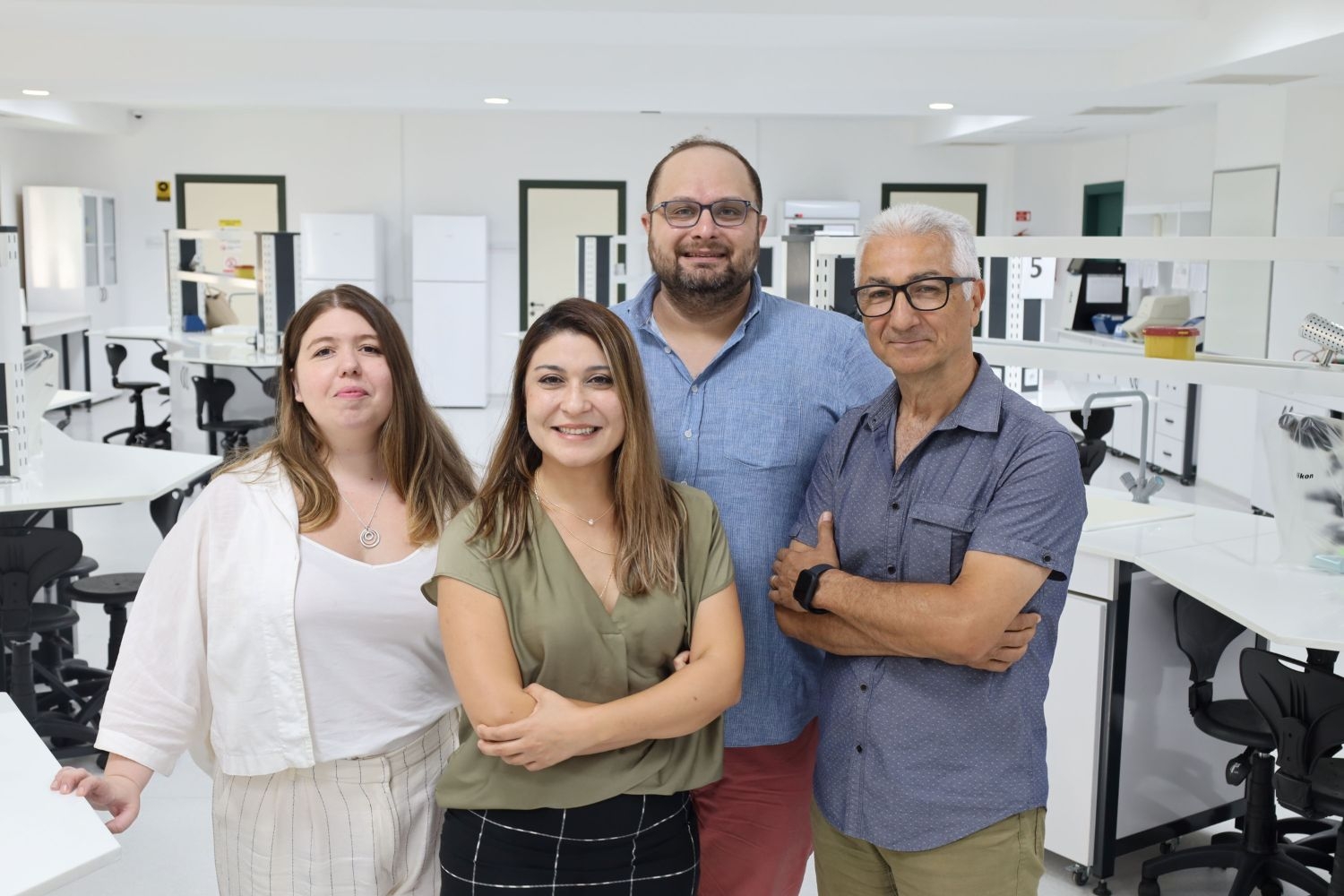
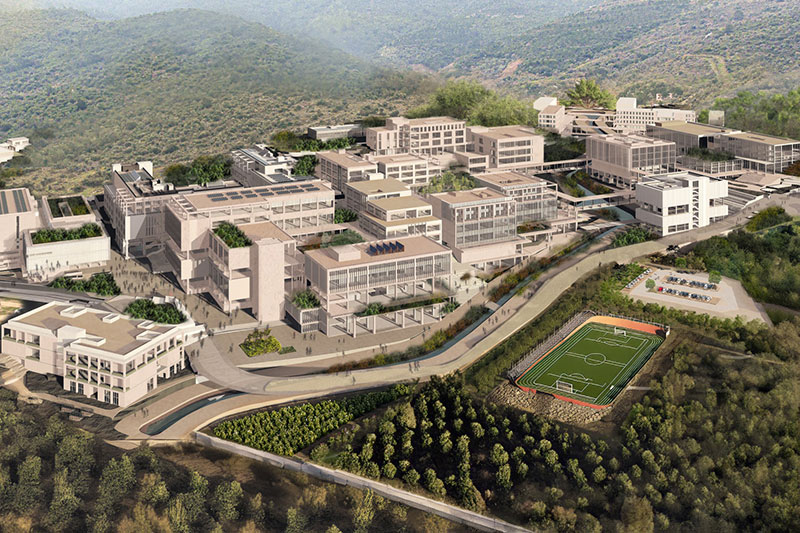
IZMIR UNIVERSITY OF ECONOMICS GÜZELBAHÇE CAMPUS
DetailsGLOBAL CAREER
As Izmir University of Economics transforms into a world-class university, it also raises successful young people with global competence.
More..CONTRIBUTION TO SCIENCE
Izmir University of Economics produces qualified knowledge and competent technologies.
More..VALUING PEOPLE
Izmir University of Economics sees producing social benefit as its reason for existence.
More..
You are one step ahead with your graduate education at Izmir University of Economics.